

For immediate release: 18th March 2026
- New research shows link between spending power and improved climate action from councils
- Every £200 per capita increase in budget provides a 0.8% increase in climate performance
- Public engagement has a bigger impact than spending power on climate action success from councils
Councils with higher spending power do better on climate action
New analysis, published today, shows that English councils with higher spending power score higher in Climate Emergency UK’s public assessment of local councils’ climate action, the Council Climate Action Scorecards.
At a time when nearly 40% of English councils say they will require financial bailouts in the coming years, the report concludes that climate action from councils may be under threat, especially as it is not currently a statutory duty for English councils.
Working with academics from the University of York and Nottingham Trent University, Climate Emergency UK (CE UK) have analysed the results of the 2025 Council Climate Action Scorecards, exploring links between councils in England’s spending power per capita, and factors including: the success of their climate action; and the amount of public engagement around it.
Amongst single-tier and county councils in England, for every £200 per capita increase in a council’s spending power, the academics found a 0.8% improvement in their Action Scorecard performance.
Dr Liam Clegg, Senior Lecturer at the University of York, who conducted the data analysis, said, “Our report shows that council resourcing matters. Overall, councils with higher spending power display stronger climate performance. This insight bolsters calls to introduce a statutory duty to act on climate change alongside targeted government financing to support action”.
Isaac Beevor, Partnerships Director at CE UK, added that if climate action were a statutory duty for councils, as in Scotland, there would be corresponding funding and guidance for English councils from the UK government.
“Following work from us and others across the sector, the LGA now has a formal position in favour of a statutory duty for climate action for English councils. This is huge, and with councils’ budgets facing bleak futures and recent winter flooding affecting English residents, powers and funding to adapt and mitigate against the changing climate have never been more needed”.
The report also found that a one percentage point increase in public support for climate action is linked to a 1.9 percentage point improvement in a council’s Scorecard performance.
Peter Eckersley, Associate Professor at Nottingham Trent University, said, “CE UK’s Climate Scorecards provide the most comprehensive independent assessment of local climate action in the UK. They help us to track how the country as a whole is progressing, and highlight what ministers and councils could do to achieve net zero more quickly and more effectively.
“Our analysis emphasises that councils perform better where local people are more in favour of net zero policies. This suggests that governments at all levels need to maintain support for climate action to keep the momentum going, particularly in a context of growing skepticism around net zero.”
Among residents, 64% of the UK population still want to see the government’s target for net zero to be 2050, despite two-thirds of local authorities in England not being confident they will meet their own local net-zero targets by 2050.
END
Contact press@climateemergency.uk or Annie at Climate Emergency UK on 07934486877 for more information
Notes for Editors
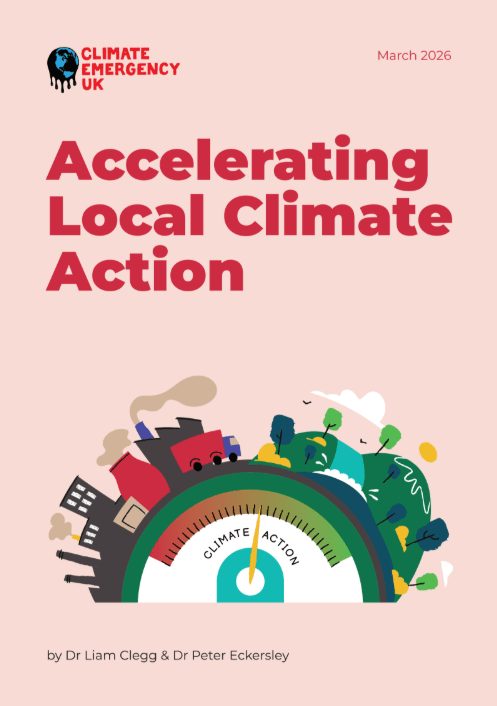
- You will be able to see a copy of the report from 18th March on this link.
- The report analyses the 2025 Council Climate Action Scorecards results which can be found here
- The Scorecards is a project of Climate Emergency UK, in partnership with mySociety
- The report was sponsored by Unity Trust Bank
- Images below
Background information
- Climate Emergency UK is a not-for-profit community interest company which has been working with councils and residents since 2019 to share best practice about what councils can do to tackle the climate and ecological emergency and to encourage effective action.
- Last year, Climate Emergency UK published the 2025 Council Climate Action Scorecards in June which was an assessment of councils’ action plans they’ve taken towards net zero. This is the first time CE UK were able to compare council climate action against 2023 Action Scorecards, with the average score being 38%, only 6 percentage points higher than 2023
- The report “Accelerating Local Climate Action” was commissioned by Climate Emergency UK (CE UK). The main analysis of the scorecards data was conducted by Dr Liam Clegg (University of York) and Dr Peter Eckersley (Nottingham Trent University).
- The underlying scorecard data is available from CE UK and further details of the analysis are available on request.
JOIN
our mailing list